The 8 best Sikh heritage sites in Punjab, ranked
 Nihang Sikhs on horseback at Hola Mohalla celebrations
Eight sites central to Sikh history across Punjab, ranked by historical weight, atmosphere and what you actually see when you get there.
1. Harmandir Sahib (Golden Temple), Amritsar
The foundation stone was laid in 1588 by the Muslim Sufi Mian Mir on the invitation of Guru Arjan Dev. The current gilded upper stories were commissioned by Maharaja Ranjit Singh in 1809. The Guru Granth Sahib was installed in 1604 and is still ceremonially processed from the Akal Takht each morning and returned each night. This is the working centre of the Sikh faith, not a monument to it. Every other site on this list orbits around what happens here.
Practical: enter through the clock-tower gate opposite Heritage Street, deposit shoes at the free Joda Ghar, cover your head. Free 24 hours. The sanctum queue in the causeway can be two hours mid-morning and 20 minutes at 4am. The Akal Takht opposite is the temporal seat of Sikh authority and the site of the 1984 Operation Blue Star damage — the rebuilt structure is visible; the political weight is not on the caption board.
2. Takht Sri Kesgarh Sahib, Anandpur Sahib
One of the five Takhts (thrones of authority) of Sikhism, Kesgarh Sahib is where Guru Gobind Singh founded the Khalsa on Baisakhi 1699 by initiating the Panj Pyare — the five beloved ones — with amrit. The gurdwara stands on the exact site of the ceremony on a low hill in Anandpur Sahib. The historic weapons preserved inside include Guru Gobind Singh's khanda, katar and chakram; they are displayed in the sanctum on request.
Anandpur is 85km from Chandigarh, 2 hours by car. Free, open 24 hours, langar available. Combine with the Virasat-e-Khalsa museum a kilometre away for the historical context. Hola Mohalla, the martial festival established by Guru Gobind Singh, is held in March each year with Nihang cavalry displays, mock battles and gatka demonstrations — attendance climbs above a million on peak days. Off-festival the town is calm and the gurdwara is one of the most affecting on this list.
3. Gurdwara Fatehgarh Sahib
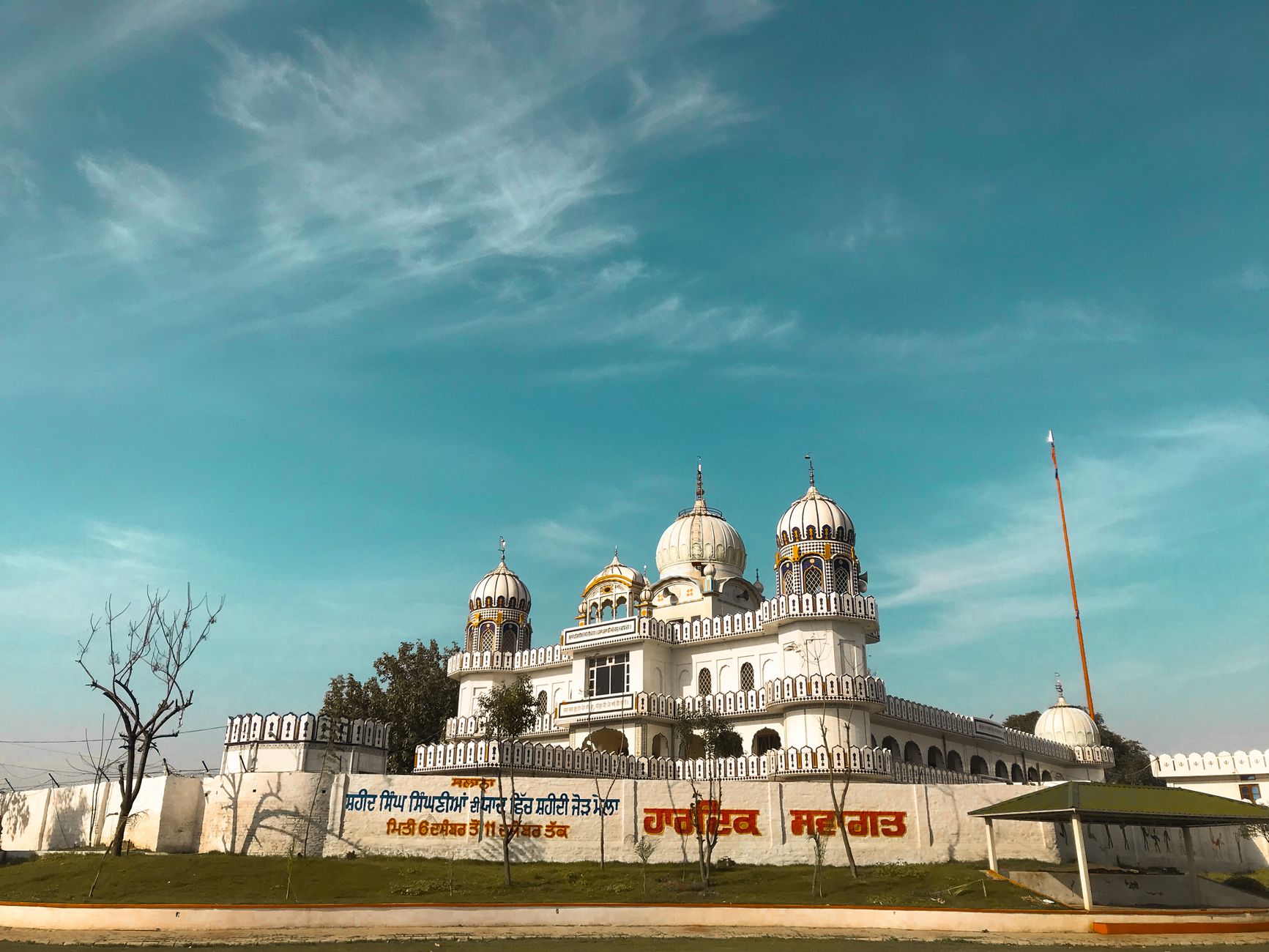
The site where Guru Gobind Singh's two younger sons, Baba Zorawar Singh (7) and Baba Fateh Singh (5), were bricked into a wall alive on orders of the Mughal governor Wazir Khan in December 1705. The Bhora Sahib in the basement of the current gurdwara preserves the exact spot. Their grandmother Mata Gujri died in captivity in the adjacent Thanda Burj. The three-day Shaheedi Jor Mela around 26-28 December draws over a million pilgrims.
Fatehgarh Sahib town is 55km from Chandigarh, 75 minutes by car. Free, open 24 hours, langar. The narrative weight of this site is heavier than the physical scale suggests — the gurdwara complex is compact, and the emotional impact comes from reading the story before you visit. Nearby Aam Khas Bagh, the ruined Mughal serai, adds context. Ranked third because the historical density is exceptional even though the site is architecturally modest.
4. Gurdwara Baba Atal, Amritsar
A nine-storey octagonal gurdwara 200m south of the Golden Temple, built between 1778 and 1784 in memory of Atal Rai, the young son of Guru Hargobind who died aged nine. At 40 metres it is the tallest gurdwara in India and each of its nine floors represents a year of Atal Rai's life. The frescoes inside — floral panels, scenes from the Janamsakhi — are eighteenth-century original work, badly faded, urgently in need of conservation.
Free, open 24 hours, walk up all nine floors for the view over the Harmandir Sahib complex from the top. Almost every visitor to the Golden Temple misses this despite the two-minute walk, which is why it ranks fourth on quality — it is functionally an under-visited masterpiece. Combine with a lassi at Ahuja Milk Bhandar around the corner. The upper stories can be closed for restoration; check at the ground-floor office.
5. Gurdwara Ber Sahib, Sultanpur Lodhi
Guru Nanak lived in Sultanpur Lodhi in Kapurthala district for 14 years — his brother-in-law Jai Ram worked in the Nawab's court and Guru Nanak served as a modikhana keeper. It is here on the banks of the Kali Bein that he had his revelatory disappearance for three days in 1499 and emerged proclaiming Na koi Hindu, Na koi Musalman. Gurdwara Ber Sahib is built around the jujube tree under which he meditated.
The town holds seven gurdwaras associated with Guru Nanak's residence. The 550th Prakash Purab in 2019 saw major restoration and infrastructure improvements including a corridor to the Kali Bein bathing ghat. Sultanpur Lodhi is 40km from Jalandhar, 90km from Amritsar. Free, quiet, and among the most historically formative sites in Sikh geography. Ranked fifth because it is a full detour from any main route but the biographical weight is unmatched.
6. Kartarpur Sahib corridor terminal, Dera Baba Nanak
Guru Nanak spent his final 18 years and died in 1539 at Kartarpur Sahib, now 4.5km inside Pakistan on the west bank of the Ravi. The visa-free Kartarpur Corridor opened in November 2019 allows Indian passport-holders to visit the shrine for a day trip. The Indian terminal is at Dera Baba Nanak in Gurdaspur district, 50km northeast of Amritsar. Pre-register online at prakashpurb550.mha.gov.in, carry passport, cross by 3pm.
For visitors who cannot get across, the Indian-side viewing platform at Dera Baba Nanak has telescopes trained on the Pakistani gurdwara and the corridor pathway. The Dera Baba Nanak gurdwara itself, on the Indian bank, holds Guru Nanak's chola. Free, open 24 hours. Ranked sixth because the corridor process adds a full day of logistics but the site — Guru Nanak's actual place of death — is fundamental.
7. Gurdwara Tarn Taran Sahib
Founded by Guru Arjan Dev in 1590, Tarn Taran Sahib has the largest sarovar of any gurdwara — larger than the Golden Temple's, though less famous. The tank is 1,000 feet square and the gurdwara sits on its western edge. The monthly Amavasya (new-moon) gathering draws over 100,000 pilgrims and the Baisakhi mela in April fills the town. Free, open 24 hours, langar.
Tarn Taran is 25km south of Amritsar on the road to Khem Karan and the Pakistan border. A one-hour taxi from the Golden Temple. The complex is architecturally similar to Harmandir Sahib — sanctum on a causeway, marble parikrama — but at a smaller scale and with almost no tourist traffic. Ranked seventh because it is a working gurdwara without the crowding, and it deserves the visit as a counterpoint to the intensity of Amritsar. Skip on Amavasya unless you want a mela experience.
8. Damdama Sahib, Talwandi Sabo
One of the five Takhts, Damdama Sahib is where Guru Gobind Singh compiled the final recension of the Guru Granth Sahib in 1706 after his flight from Anandpur. The name means resting place. The town — Talwandi Sabo in Bathinda district — is 350km from Amritsar and 250km from Chandigarh, deep in the Malwa cotton belt. Vaisakhi celebrations here draw a million.
The gurdwara complex is calm, low, whitewashed, and off any tourist circuit. The library holds nineteenth-century manuscript copies. Nearby Gurusar Sahib and other associated sites can be done in the same afternoon. Free, langar, open 24 hours. Ranked eighth because the drive is long and the site does not visually compete with Amritsar or Anandpur — but as one of the five Takhts and the location where the Adi Granth received its final form, its historical rank is second to none. Combine with a Bathinda overnight.
Before you book
What people ask before booking Amritsar.
No. Every gurdwara on this list is open to all visitors regardless of faith. You must cover your head (cloths are provided free), remove shoes, wash your feet at the entrance troughs, and not carry tobacco or alcohol into the complex. Photography is generally permitted in the parikrama but not inside sanctums.
Everyone sits in rows on the floor and is served equally. Accept what is offered — refusing dishes is rude. Eat with your right hand or the spoon provided. When finished, take your thali to the wash area and hand it to a volunteer. Donations are optional and made only at the marked counter, not to servers.
Yes. A four-day loop: Amritsar (Harmandir, Baba Atal, Tarn Taran), then Dera Baba Nanak for the Kartarpur Corridor if pre-booked, then across to Anandpur Sahib and Fatehgarh Sahib, ending in Chandigarh. Sultanpur Lodhi and Damdama Sahib require separate detours.
Hola Mohalla is held the day after Holi (typically mid-March). The Nihang cavalry displays, gatka martial arts and mock battles at Anandpur Sahib are extraordinary and there is nothing comparable elsewhere. Book accommodation two months out — the town of 15,000 hosts over a million and every guesthouse fills.