Amritsar Walled City Walking Route: 12 Stops Over 4 Hours
 Narrow lane in Amritsar walled city with balconies and hanging signs
A 3.5 km loop through the katras and bazaars of the old city, timed to hit the Golden Temple langar at the right hour and finish at Gurdas Ram Jalebi Wala before the queue.
Stop 1-2: Town Hall and the Partition Museum (08:30-09:45)
Start at Town Hall on Hall Bazaar at 08:30 — early enough that the shopkeepers are still washing their steps and you can actually see the colonial facade. The Partition Museum inside opens at 10:00 but the ticket queue starts forming by 09:30 and it is worth being first through the door. Entry is ₹250 for Indians and ₹500 for foreigners; give it 90 minutes minimum. The oral history recordings in Gallery 4 are the reason to come; the physical artefacts are almost secondary.
Walk out through the Hall Gate arch — one of the twelve historic gates of the walled city, most of which are gone. From here you can already see the spire of the Durgiana Temple to the west and hear the loudspeakers from the Golden Temple parkarma to the south. Do not go south yet. Turn east into Katra Ahluwalia and the walk proper begins. The lanes narrow to under three metres and cars are physically banned during daylight — this is why walking is the only sensible way to see this district.
Stop 3-4: Jallianwala Bagh and the memorial well (10:15-11:15)
The bagh is 200 metres south of Town Hall through a distinctive narrow entry lane that has barely changed since 1919. This is deliberate — the whole point of the massacre was that General Dyer's troops blocked this single exit. Entry is free and it opens at 06:30. The 2021 renovation is controversial and I understand why: the light installations feel excessive and the murals thin out what should be plain. But the well is untouched, and standing at its edge for five minutes is what the visit is for.
Leave via the same lane and cross the parikrama plaza toward the Golden Temple. Do not enter yet — the langar hall is your third destination and langar service is heaviest between 12:00 and 14:00. Instead, take a chai break at one of the stalls on Guru Bazaar for ₹15 and watch the rhythm of pilgrims removing shoes at the shoe deposit. The main deposit near the clock tower entrance takes 20-30 minutes at midday; the smaller Ghanta Ghar side deposit is usually under 10.
Stop 5: Golden Temple parikrama and langar (11:30-13:00)
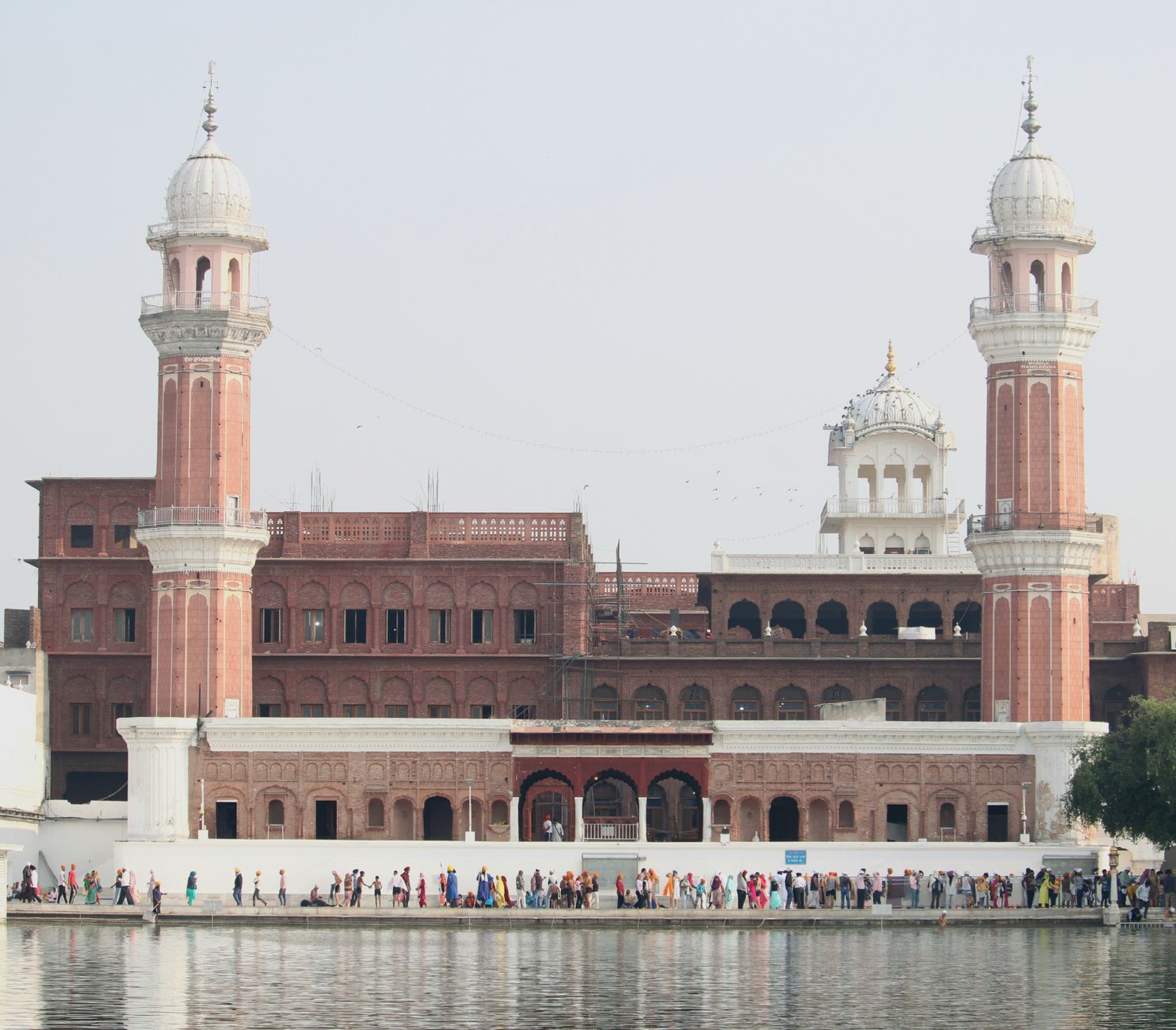
Enter through the Ghanta Ghar side, cover your head with the free scarves at the entrance, and walk the parikrama clockwise. Do not queue for the inner sanctum on this walk — the wait is 90 minutes minimum and you have a route to finish. The parikrama itself takes 25 minutes at a slow pace. The reflection of the Harmandir Sahib is best from the north-west corner at midday when the sun is high enough to light the gold plating.
For langar, follow the crowds to the eastern hall. You will queue for five minutes for a steel tray, sit cross-legged in rows of 200, and be served roti, dal, sabzi and kheer within another five. Total time inside the hall is 20 minutes. Do not photograph the sevadars serving — it is considered rude. Wash your own tray at the exit conveyor. Leave a donation of whatever you can at the golak on the way out; there is no expected amount.
Stop 6-7: Katra Jaimal Singh and the textile bazaar (13:15-14:15)
Exit the Golden Temple complex via the Atta Mandi gate on the west side, not the main plaza. You emerge directly into Katra Jaimal Singh, which is the wholesale textile market that supplies retailers across north India. Phulkari dupattas start at ₹400 for machine work and climb to ₹4,000 for hand-embroidered pieces from Patiala workshops; the shop to ask for is Kapoor Brothers on the fourth lane. Fabric is sold by the metre and haggling is expected but modest — 15% off the asking price is a realistic outcome.
Continue west into Guru Bazaar for gold and silver — this is one of India's largest jewellery districts by turnover. You do not need to buy anything to enjoy the walk; the shopfronts themselves are the attraction. The Sarafa Bazaar section has narrow lanes where balconies almost touch overhead. Stop at the tiny Brijwasi sweet shop for a mid-walk kachori break (₹40) — it has been in the same location since 1936 and the owner will tell you so if you give him thirty seconds.
Stop 8-9: Thakurdwara Darianamal and the Hindu quarter (14:30-15:30)
North of Guru Bazaar the lanes open into the Hindu quarter around the Thakurdwara Darianamal temple — an 18th-century Krishna temple with painted haveli walls that most visitors never see because no one tells them it exists. Entry is free and shoes come off at the wooden door. The upper floor's frescoes were restored in 2018 with mixed results but the ground-floor courtyard is intact and quiet enough to actually sit in for ten minutes.
From here, cut across to the Qila Ahluwalia — the remains of the Ahluwalia fort, now mostly overtaken by residential encroachment. You can see two bastions from Lohgarh Chowk. This is the least tourist-friendly section of the walk and you will get stared at; that is normal, not hostile. A local resident often appears to explain the history for a small tip (₹100 is fair). Turn south again toward Chowk Passian to rejoin the retail lanes.
Stop 10-12: Amritsari lunch, jalebi finish (15:45-17:00)
Late lunch at Bharawan Da Dhaba on Town Hall Road — the thali is ₹380 and the paneer bhurji is what to order specifically. Avoid Kesar Da Dhaba for this walk; save it for a proper dinner. From Bharawan, walk 300 metres to Ahuja Milk Bhandar for a lassi (₹80, thick enough to stand a spoon in). Skip the sweet lassi tourists rave about and ask for the salted version, which is what locals drink after a heavy meal.
Final stop is Gurdas Ram Jalebi Wala on the narrow lane behind the clock tower. Arrive by 16:30 to beat the evening queue. Fresh jalebi comes off the kadai at ₹200 a kilo and you order 250 grams for two people. Eat standing in the lane — there is no seating and never will be. The walk ends here. Total distance covered is 3.5 km over 4.5 elapsed hours including all stops. Nearest hotel back is the Grand Legacy, a 400-metre walk east.
What to wear and what to leave behind
You will remove shoes at least three times (Golden Temple, Thakurdwara, and probably at Bharawan Da Dhaba's upper hall) so wear slip-ons. A head covering is required at the Golden Temple; the free scarves are fine but bring your own if you have colour preferences. Shorts are frowned on inside the complex — knee-length at minimum. Carry a small daypack rather than a shoulder bag; the lanes get squeezed and swinging bags catch on stalls.
Leave the DSLR at the hotel. Every stop on this walk is either better photographed on a phone or actively hostile to large cameras (Jallianwala Bagh, the langar hall). Carry ₹2,000 in small notes — most stalls will not break a ₹500 and UPI works patchily inside the old city. Water is available everywhere but toilets are not; use the facilities at the Golden Temple complex, which are free and cleaned every 30 minutes, before you head into the katras.
Before you book
What people ask before booking Amritsar.
Yes — the Amritsar Heritage Walk operated by the Punjab tourism department leaves Town Hall at 08:00 daily and covers a similar route for ₹250. It skips the langar section and finishes by 11:00. Private guides at the Golden Temple information counter charge ₹800-1,200 for a half-day. Solo works fine if you have basic Hindi or Punjabi and are comfortable asking directions.
During daylight, yes — this is one of the most heavily populated pilgrim districts in India and there are always families and elderly women on every lane. After 20:00 the retail sections empty and I would stick to the main routes back to your hotel. Attire matters less than confidence; walk purposefully and you will attract almost no attention.
Cycle rickshaws cannot enter most of the katras — the lanes are too narrow. What tour operators sell as an old city rickshaw tour is really a loop around the outside on Hall Bazaar and Cooper Road. You see the district's edges without ever being inside it. Walking is the only way to actually experience the walled city, and 3.5 km is manageable for most people.